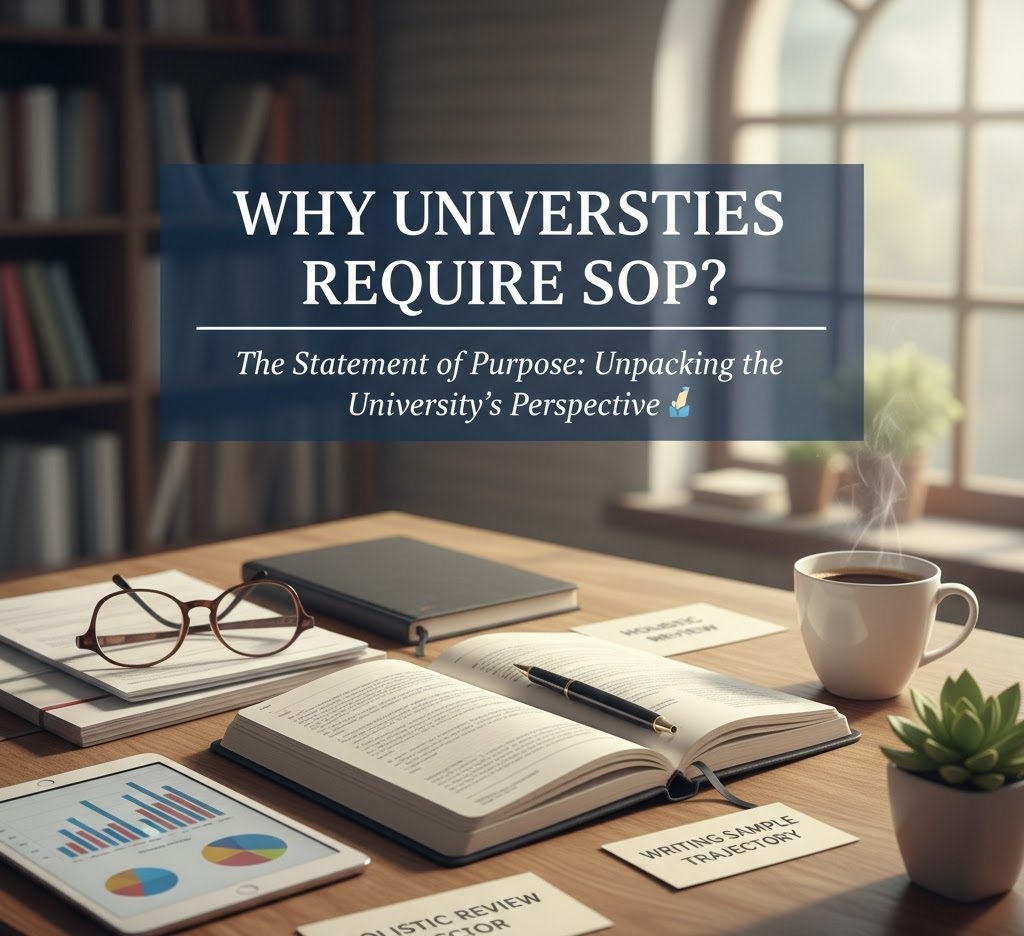
The Statement of Purpose (SOP): For many students, it’s the final, most daunting hurdle in their graduate or undergraduate application. You’ve compiled stellar transcripts, aced the GRE/GMAT, and polished your résumé. But then comes the prompt: Tell us about yourself and why you want to join our program.
It might seem like redundant paperwork, a mere formality after years of academic performance. But to a university admissions committee, the SOP is arguably the most crucial piece of the puzzle. It’s the difference between a high-scoring application and a compelling candidate.
So, why do top universities globally mandate this document? Here are the five core reasons the SOP remains a non-negotiable requirement:
1. The Human Element: Moving Beyond Metrics
Your GPA, test scores, and research papers offer a quantitative snapshot of your abilities, but they tell a limited story. They show what you achieved, but not who you are or how you think.
The SOP provides the qualitative context necessary for a holistic review. Admissions committees use it to:
- Explain Gaps or Irregularities: Did you take time off? Did you switch majors? Did you have a lower score one semester? The SOP is your chance to provide a mature, reasoned explanation, transforming a potential red flag into a narrative of resilience or focused redirection.
- Evaluate Intangible Qualities: The document reveals your self-awareness, maturity, critical thinking skills, and ability to reflect on your experiences—qualities essential for success in advanced study.
2. Assessing Alignment: The “Why Us” Factor
Every university program has a unique mission, specific faculty expertise, and a distinct research focus. They aren’t just looking for bright students; they are looking for the right fit.
The SOP is the primary tool to gauge this academic and institutional alignment:
- Understanding Motivation (The “Why”): The committee wants to know your intellectual curiosity and the driving force behind your career goals. They want to see that you understand the rigor of the program and are genuinely committed to the field.
- Demonstrating Fit (The “Why Them”): A compelling SOP explicitly connects your past experiences (projects, internships, research) to the program’s specific offerings (Professor X’s lab, the interdisciplinary curriculum, specific course modules). It proves you haven’t just sent a generic application; you’ve done your homework.
3. Gauging Potential: A Critical Writing Sample
Graduate-level work, in particular, requires sophisticated communication. You will be writing grant proposals, research papers, theses, and presenting complex ideas clearly. Your SOP serves as a direct writing sample.
Admissions officers use the document to evaluate:
- Clarity and Structure: Can you articulate complex ideas logically and succinctly within a strict word limit?
- Command of Language: Does your writing reflect the professional standard expected of a graduate student or scholar?
- Persuasion: Can you successfully argue your case for admission?
A poorly written SOP, even from a high-achieving student, signals a potential struggle with the communication demands of the program.
4. Projecting the Future: Career and Research Trajectory
A university’s reputation is built on the success of its alumni. When they admit you, they are investing in your future potential.
The SOP requires you to outline your post-graduation goals, allowing the committee to see you as a future contributor to your field:
- Specific Goals: Do you plan to pursue a Ph.D.? Enter a specific industry? Found a startup? The committee looks for goals that are ambitious yet achievable and directly relate to the degree you seek.
- Alumni Network: By understanding your career path, they can ensure your aspirations align with the opportunities the university can provide, ultimately strengthening their professional network and reputation.
The Takeaway
The Statement of Purpose is not an autobiography; it is an argumentative essay pitching you as the ideal candidate. It’s where you weave your impressive achievements into a coherent, passionate narrative that showcases not only your aptitude but your genuine purpose.
Recognizing the SOP’s role as a vital tool for holistic, qualitative, and mission-based evaluation is the first step toward crafting a truly impactful application. Your scores get you noticed, but your SOP gets you admitted.